 Cape Town Muslim Events
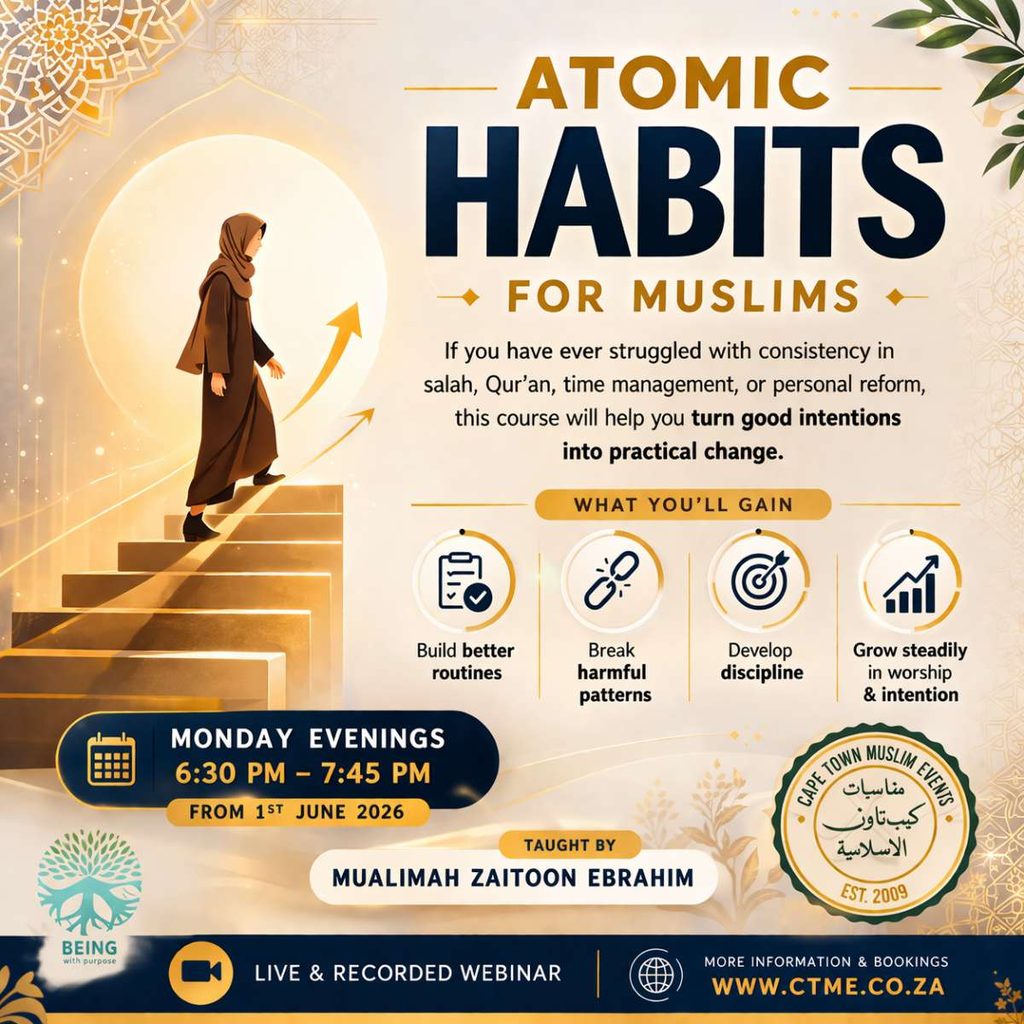
Atomic Habits for Muslims
A practical 4-week online course on discipline, consistency, and spiritual growth through an Islamic lens.
Course Overview
Lasting change rarely begins with giant leaps. More often, it begins with small, sincere actions repeated with consistency for the sake of Allah. Atomic Habits for Muslims is a practical 4-week online course designed to help students build beneficial routines, break harmful patterns, and develop a more disciplined and spiritually grounded life.
Through an Islamic lens, this course explores how daily habits shape identity, character, worship, and momentum. Students will learn how intention, environment, repetition, and self-awareness all influence behaviour, and how small changes in these areas can lead to meaningful spiritual and personal transformation over time.
This is not simply a self-help course about productivity. It is a guided effort to connect personal growth to the worship of Allah. Whether a person is trying to improve salah, become more regular with Qur’an, manage time better, leave sinful habits, or simply become more consistent in daily responsibilities, this course offers a realistic and structured path forward.
The course is especially suited to those who feel stuck between good intentions and inconsistent action. It helps students move from inspiration to implementation by focusing on manageable steps, steady discipline, and sustainable systems for growth.
What Students Will Gain
- A realistic framework for building small but powerful habits.
- Islamically anchored strategies for discipline, identity, and consistency.
- Practical tools for reducing distractions and sustaining long-term growth.
Detailed Weekly Breakdown
Week 1 · Small Habits, Big Change
This opening session lays the foundation for the course by showing how tiny actions, when repeated consistently, can reshape a person’s life. Students will explore the Islamic value of steady deeds and reflect on how small acts of worship, discipline, and obedience often carry the greatest long-term impact.
- Why people fail when they rely only on motivation.
- Why small actions matter in Islam and in behaviour change.
- How to identify one habit that can become a starting point for wider reform.
Week 2 · Identity, Intention, and Discipline
This session focuses on who we are becoming through what we repeatedly do. Students will consider how habits reinforce identity and how niyyah transforms ordinary routines into acts of worship. The discussion also highlights how discipline is strengthened gradually, not instantly.
- Linking habits to identity: What kind of Muslim am I becoming?
- The role of sincere intention in daily routines.
- How to stack beneficial habits onto existing routines such as salah, commuting, study time, or evenings at home.
Week 3 · Breaking Bad Habits and Removing Barriers
Reform does not only mean adding good habits; it also means weakening the routines that keep a person stuck. In this week, students examine common triggers, patterns of procrastination, digital distractions, and spiritual laziness. They will learn how to make harmful habits harder and beneficial habits easier.
- Spotting triggers, excuses, and environments that reinforce bad habits.
- Replacing destructive cycles with healthier alternatives.
- Practical ways to reduce access to distractions and create friction against disobedience.
Week 4 · Systems for Consistency and Long-Term Growth
The final week helps students move from a short course experience into a sustainable long-term lifestyle. Rather than chasing emotional highs, students will build personal systems that support daily worship, improved character, productive use of time, and steady progress after the course ends.
- How to create a personal rhythm for worship, reflection, learning, and responsibility.
- Tracking progress without becoming discouraged by setbacks.
- How to recover quickly after a bad day and continue with consistency.
Who Should Attend
- Muslims seeking practical and spiritually anchored self-improvement.
- Students, professionals, parents, and community members wanting better routines.
- Those struggling with consistency in worship, discipline, time management, or personal reform.
- Anyone looking for a realistic path to build good habits and weaken harmful ones.
Learning Outcomes
- Understand how habits are formed and how they can be changed in a sustainable way.
- Recognise the role of niyyah, identity, and environment in personal growth.
- Build small daily systems that support worship, good character, and responsible living.
- Identify triggers behind unhealthy or sinful habits and develop practical responses.
- Create a personal growth plan focused on steady change rather than short-lived motivation.
Educator
Mualimah Zaitoon Ebrahim
Zaitoon Ebrahim, a Cape Town native, is a motivational speaker, artist, author, and mother of two. She holds a Bachelor’s in Islamic Theology and has earned diplomas in Project Management and Didactics, along with certifications in Life Coaching, NLP, CBT, and Therapeutic Art Coaching. As a dedicated Mualimah, she continues to enhance her skills to better serve the Ummah.
Logistics
Hosted on: Zoom Webinar
Format: Designed in an easy-to-follow format
Notes: PDF notes will be posted in the group
Attendance: Live attendance is recommended whenever possible
Recordings: Available for registered students who cannot attend live
Questions: May be sent to the WhatsApp Admin
EFT Payments
Bank Name: Standard Bank
Account Name: Cape Town Muslim Events
Account Number: 300794711
Account Type: Cheque Account
Reference: Your Name, Surname, and Course code (#AHM684)
WhatsApp POP to: CTME Class – 0729701435
ATOMIC HABITS FOR MUSLIMS [AHM684]
NB! The form is a registration for one person only.
